Category Archives: Fishing Spots

Moreton Bay Artificial Reefs – West Peel Reef

West Peel Artificial Reef

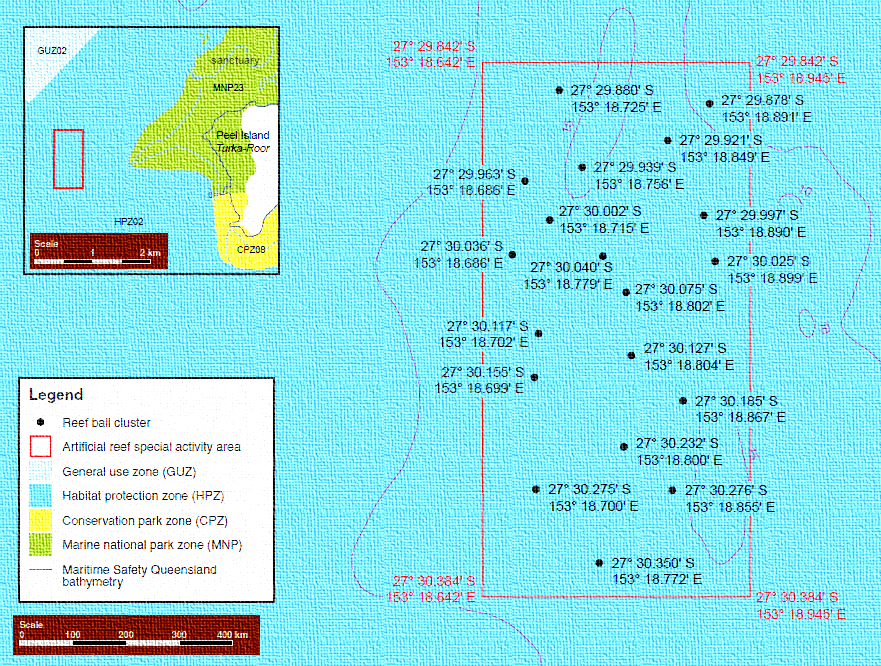
West Peel Artificial Reef is a 50ha area of clustered concrete reef balls in about 15m of water on the west side of Peel Island.

The reef was installed in 2010, with more reef balls added in 2012 and 2013.

The reef is made of 341 reef balls in 19 clusters of 10 to 16 balls of varying sizes, rising to almost a metre off the seabed.

The balls within each cluster are spaced a few metres apart and each cluster is between 100m to 200m apart.

This is a reasonably sheltered location near boat ramps, but it gets choppy with a sea breeze and runout tide combination.

West Peel Reef Fish Species

The reef does not look much on a sonar, and often produces small fish, but jewfish are caught at times.

Other species include pink snapper, tricky snapper (“grassies”), sweetlip, cod, flathead and tuskfish.

Pelagic fish pass through on occasion, including mackerel and cobia.

West Peel Reef GPS Marks

Reef ball clusters

27 29.880S 153 18.725E
27 29.921S 153 18.849E
27 30.002S 153 18.715E
27 29.997S 153 18.890E
27 30.075S 153 18.802E
27 30.117S 153 18.702E
27 30.185S 153 18.867E
27 30.232S 153 18.800E
27 30.275S 153 18.700E
27 30.276S 153 18.855E
27 30.350S 153 18.772E

Back to the NSW/ACT Fishing Map
Back to the NT Fishing Map
Back to the Queensland Fishing Map
Back to the SA Fishing Map
Back to the Tasmanian Fishing Map
Back to the Victorian Fishing Map
Back to the WA Fishing Map

Email corrections, additions, pictures or video here.
Moreton Bay Artificial Reefs – Harry Atkinson Reef

Harry Atkinson Artificial Ree

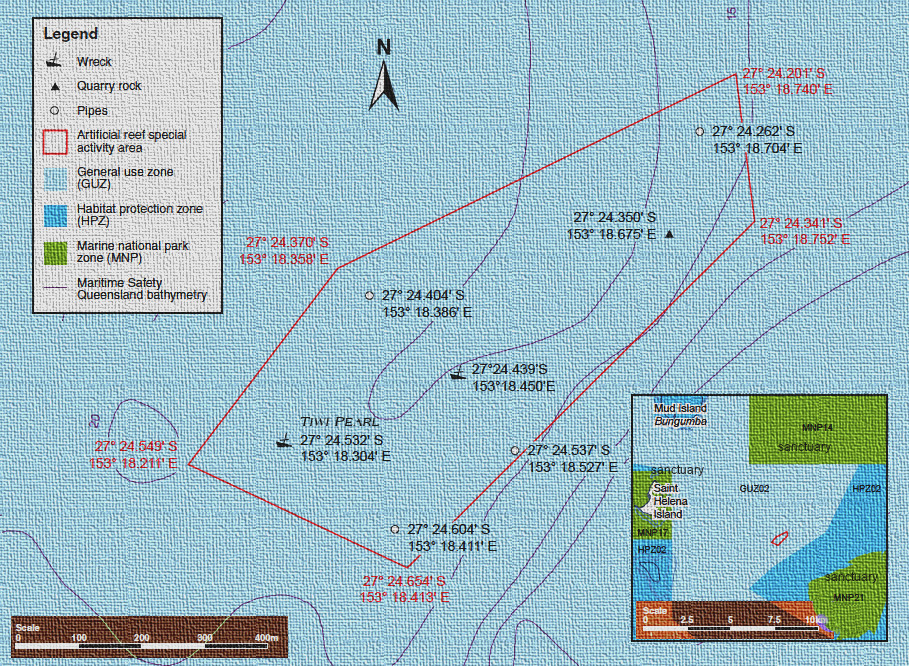
The Harry Atkinson Artificial Reef is 7km east-south-east of St Helena Island, covering 34ha in about 21m of water.

The reef was created in 1975 with 17,000 car tyres.

In 1987, 200 shopping trolleys were added.

In 2008, about 150 cubic metres of quarried rock was added.

The 24m Tiwi Pearl was scuttled on-site in 2010, standing upright. The highest point is 12m up from the sea floor.

Also in 2010, 450 tonnes of concrete pipe was deployed in four locations.

Each cluster was 23 pipes of different sizes, ranging from 2.5m to 6m above the seabed.

In 2014, a 26m, 60-tonne barge was scuttled.

Harry Atkinson Artificial Reef Fish Species

The reef produces a lot of small fish, and a few bigger ones.

The main catch is pink snapper, tricky snapper (“grassies), tuskfish, sweetlip, flathead and jewfish.

Passing mackerel are caught and occasional cobia.

Fish the turn of the tide, be sure to move if you don’t get bites, and try to fish mid-week and at night when boating traffic is lower.

Harry Atkinson Artificial Reef GPS Marks

Boundaries
27 24.029S 153 18.642E
27 24.257S 153 18.928E
27 24.553S 153 18.048E
27 24.794S 153 18.405E

Tiwi Pearl
27 24.532S 153 18.304E

Quarry Rocks
27 24.350S 153 18.675E

Pipes
27 24.262S 153 18.704E
27 24.404S 153 18.386E
27 24.537S 153 18.527E
27 24.604S 153 18.411E

Back to the NSW/ACT Fishing Map
Back to the NT Fishing Map
Back to the Queensland Fishing Map
Back to the SA Fishing Map
Back to the Tasmanian Fishing Map
Back to the Victorian Fishing Map
Back to the WA Fishing Map

Email corrections, additions, pictures or video here.

Kingscliff, New South Wales

Kingscliff has good surf fishing and some rock wall fishing.

Surf fishing for tailor is usually good in an area about a kilometre from the bowls club, but the gutters move around.

The southern wall of Cudgen Creek is a good spot with occasional very large mulloway caught there, as well as bream, tailor, luderick and flathead.

Immediately south of the southern wall are low-tide spots among the rocks, these fish well for tailor, bream, snapper, mulloway and more, but it is a hazardous area.

Cudgen Creek has whiting, flathead, bream, mangrove jacks and luderick.

There is reefy bottom 500m or so north of the creek mouth, and extensive reef further offshore.

Kayak fishing the inshore reefs is a popular activity, with snapper, cobia, kingfish, morwong, spangled emperor, cod and mackerel caught.

Tailor fishing in this area is from July to February, with the biggest fish often caught at night in summer.

flathead, whiting, bream and dart are the common catch in the surf, best in the early morning.

Other nearby spots to try include the Tweed River, Fingal Head and Norries Head.

At the Tweed, big whiting are caught at the mouth of the inlet near the caravan park at Chinderah.

Use worms for bait at night on ultralight tackle.

South of Kingscliff, Hastings Point rocks produce mainly yellowfin bream, with a chance of passing tailor and mulloway.

Cudgera Creek at Hastings Point produces flathead, bream, whiting, mangrove jacks and luderick.

Use lures to get past the small bream in the creeks.

Mulloway are a chance at all the local creek mouths after prolonged heavy rain.

The road south to Pottsville follows the beach and it is easy to stop along the way and look for gutters.

Bream, tarwhine, tailor, dart, flathead, whiting and mulloway can be caught in the surf throughout this area.

Shallow Mooball Creek, between Hastings Point and Pottsville, has flathead.

South of Pottsville is a beach near a rock patch “Black Rocks” – this area produces quality tailor.

Beaches in this region have cockles (pipis) and beach worms.

Kingscliff tides
Kingscliff coastline
NSW fishing regulations
NSW marine parks

Email corrections, additions, pictures or video here.
