Category Archives: Fishing Spots

Jervis Bay, New South Wales

Jervis Bay is a hugely popular fishing destination with a combination of estuary, rock, surf and game fishing.

The bay is about three times the size of Sydney Harbour, with plenty of space for boating during holiday periods.

It is less than a three-hour drive south of Sydney,

Jervis Bay has some of Australia’s best game fishing rock platforms, being one of the few Aussie landbased locations where yellowfin tuna and marlin are reliably caught.

There are usually ample squid and bread and butter species in the bay and for this reason, along with the great surroundings, holiday periods can be busy.

Offshore there are canyons along the Continental Shelf that produce blue, striped and black marlin, and mako sharks.

Yellowfin, bonito and albacore are the main tuna species.

Gamefish are taken mainly in the warmer months.

Yellowtail kingfish and tailor numbers vary from year to year, while drummer and bream are almost always present off the rocks.

Jervis Bay Marine Park covers about 100km of coastline from Kinghorn Point south to Bherwerre Beach.

About 80 per cent of the park is zoned “habitat protection” and “general purpose” which both allow recreational fishing, but there are several sanctuary zones.

The small towns around the bay are Callala Bay, Callala Beach, Myola, Woollamia, Huskisson, Vincentia and Hyams Beach, with accommodation, van parks and camping grounds.

The southern bay is Commonwealth territory with naval training facility HMAS Creswell.

This area forms the Booderee National Park.

Jervis Bay has protected low-energy beaches, and clear waters over fertile seagrass beds, making for great squidding and enjoyable boating.

Big flathead can be caught from most beaches.

Reefs extend north and south of the bay entrance, with good fishing, but many boaters go wider.

Offshore game grounds accessible from the bay include The Sir John Young Banks, JB Canyons and Drum Canyons.

The main inflowing waterway is Currumbene Creek, at Huskisson, with several smaller creeks also flowing into the bay.

The water in the bay tends to be very clear, so coastal fishing is more successful using light gear and at dusk, dawn and at night.

If you plan to chase gamefish from the rocks you will need specialist gear. The best platforms are somewhat famous and the local tackle shops will point you in the right direction.

Keep in mind that rock fishing is hazardous, and unfortunately there is some reluctance to wear life preservers among Aussie fishos.

Jervis Bay fishing spots

Murrays Beach boat ramp and rock wall – the beach is within Booderee National Park. Very clear water, best fishing as at dawn and dusk. at dusk. Great spot for squid because of the weedbeds.

Plantation Point – bream, flathead, flounder, whiting, squid and snapper.

Currarong – there is rock, beach and good boat fishing here. Beach fishing at Warrain and Abraham’s Bosom Beach, with otherr beaches a short drive away. Salmon in winter, tailor, flathead, whiting and bream off the beaches, with a chance of mulloway at night. Landbased game fishing off Point Perpendicular.

Hyams Beachbream, whiting, flathead and salmon.

Huskisson Wharf – easy family fishing but a lot of bait pickers here..

Currumbene Creek – there are several good landbased spots in this creek, expect bream, whiting, flathead, luderick and flounder.

Moona Moona Creek – try the hole under the bridge for bream, whiting, flathead and luderick.

Callala Baywhiting, bream and flathead from the beach, with squid, flathead, salmon and tailor off Callala Point rocks. The jetty next to Callala Bay boat ramp produces few fish.

In this general region, St George’s Basin Recreational Fishing Haven is another great fishing spot, with artificial reefs installed at a depth of 6.5m.

Also in this region, Lake Conjola has a similar reef.

More great fishing can be had to the north of Jervis Bay around the fishing holiday township of Nowra.

Jervis Bay fishing GPS marks

The Banks West gamefish, snapper 34 58.100S 150 52.650E
Shark Reef East 34 57.120S 150 56.460E
SHark Reef North 34 56.640S 150 56.410E
Shorna wreck 34 58.383S 150 48.627E
Morwong ground 34 58.421S 150 58.722E
Snapper reef 34 58.442S 150 59.158E
Drop-off 34 58.958S 150 55.187E
Currarong bommie 34 59.517S 150 50.089E
Currarong bommie 34 59.18S5 150 50.110E
The Banks 34.59.300S 150.51.760E
East Reef 34.59.560S 150.50.050E
The Banks 35 00.900S 151 03.710E
Huskisson patch 35.02.214S 150.40.404E
Snapper ground 35 02.320S 151 04.461E
Flat Rock snapper 35.03.924S 150.50.459E
Middle ground 35.06.090S 150.46.193E
Jervis Bay Canyon 35.08.150S 151.02.250E
Middle ground in Sussex Inlet 35.13.39S 150.36.26E

Jervis Bay tides
Jervis Bay coastline
Boodaree National Park
Jervis Bay Zoning Map
Jervis Bay Marine Park User Guide
NSW FADs
NSW stocked waters
NSW dam levels
NSW fishing regulations
NSW marine parks

Email corrections, additions, pictures or video here.

Cape Jaffa, South Australia

Cape Jaffa is an all-round fishing holiday destination, with an excellent marina, good crayfish grounds and easy landbased fishing.

A big boat is not needed to fish in close in good conditions, as there are relatively sheltered waters between Cape Jaffa and Kingston.

The shallow weed bottom comes in close to shore and king george whiting, garfish, flathead, tommies, snook and squid are usually easily found.

Within the marina salmon, flathead, trevally and bream can be caught.

The jetty produces most local species, including many squid for those who fish calm, clear mornings and evenings in warm weather.

For boaters, the substantial Margaret Brock Reef lies 7km west of Cape Jaffa, extending about 8km north and south.

There is broken ground inside the reef through to the cape, with species such as snapper, kingfish and crayfish.

Some reef areas break, including North Rock and South Breaker, and great care is required.

Cape Jaffa’s king george whiting are caught over a kilogram at times from weed patches in Wrights Bay and a spot called “The Pinnacles”.

Snapper, sharks and crayfish are caught at King Rock and North Reef, with anchoring and berleying each side of a tide change usually productive.

As well as bread and butter species, large mulloway are caught in the harbour and off the jetty at night but they are finicky, with livebait a must, preferably a squid or salmon trout.

Wrights Bay beach has big mulloway in summer. Fish a high tide at night on a full or new moon.

Outside the inner reefs, big snapper, thresher and whaler sharks, bluefin tuna and more are caught, but big boats are needed.

Cape Jaffa’s low-energy beaches are shallow but can fish well on big tides, with sheltered spots providing garfish and flounder at night for dab netters and spearers.

Weed is often present on the beaches, and weed worms make good bait.

Summer brings good conditions in this area for yellowfin whiting.

Autumn is a good time to visit Cape Jaffa and Kingston as there are fewer holidaymakers about than in summer, the seas are calm, and summer species are usually still around.

For surf fishos, there is 160km of high-energy beach leading north from Kingston to the Coorong, with plenty of 4WDers making the trip to find the best gutters for mulloway, salmon, gummy sharks and tailor.

If you plan to visit this long beach be fully prepared as there are no facilities after Kingston.

South of Cape Jaffa there are more good fishing opportunities around Robe.

Here is the SA seasonal fishing calendar for various fish species.

A reminder that special snapper rules apply in SA, and new restrictions were announced following a destructive marine algal bloom ... view details here.

Cape Jaffa weather and tides
Cape Jaffa coastline
Cape Jaffa (Kings Camp) coastline
SA boat ramps
SA fishing regulations
SA marine parks

NOTE: Special snapper rules apply in SA. More recently, new restrictions were announced following a destructive marine algal bloom … view them here.

Email corrections, additions, pictures or video here.

Upper Murray River, Victoria-NSW

One of the most popular fishing areas on the Murray RIver are located from Echuca through to Mulwala
One of the most popular fishing areas on the Murray River are located from Echuca through to Mulwala

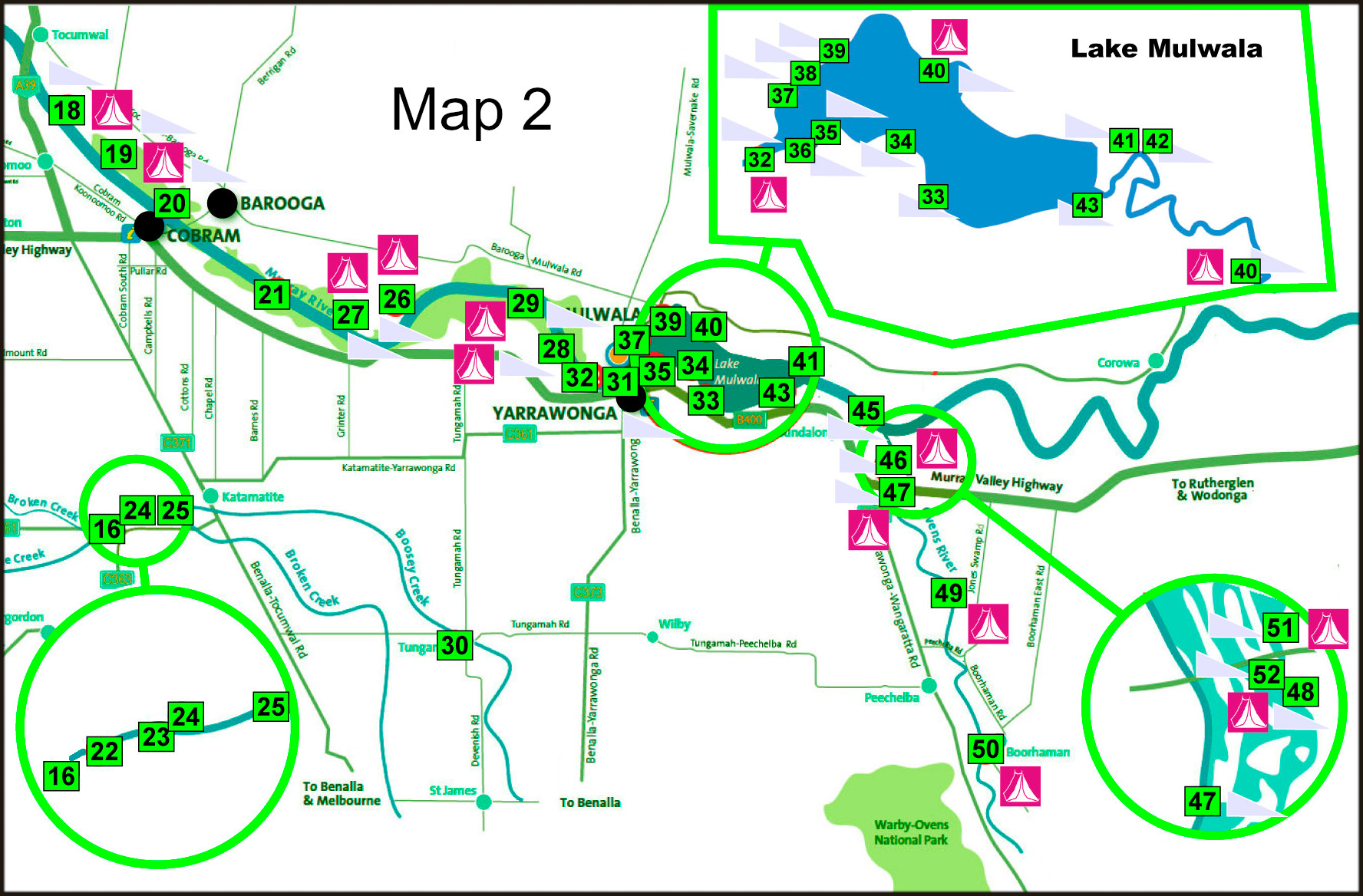
KEY TO MAPS 1 & 2
1. The Junction
2. Rices Bridge
3. The Narrows/Barmah Choke
4. Barmah Lakes
5. The Willows (under the bridge), Barmah
6. The Gulf, Barmah National Park
7. Kennedy’s Weir
8. James Bridge
9. Bourke’s Weir
10. Chinaman’s Weir
11. Nathalia’s Town Weir
12. Broken Creek near Nathalia Golf Course
13. Walsh’s Bridge
14. Stockyard Bridge
15. Numurkah Town Lake
16. Katandra Weir Invergordon
(Junction of Broken Creek and Nine Mile Creek)
17. Ulupna Island
18. Weiss Beach, Koonoomoo
19. Horseshoe Bend, Cobram Regional Park
20. Kennedy Park/Thompsons Beach
21. Thong Tree, near Backhouse Beach
22. Dip Bridge
23. Hester Rd Site 3
24. Hester Rd Site 4
25. Hester Rd Site 5
26. Duffy Bend (Bourkes Bend Track)
27. Cobrawonga (Dead River Track)
28. Forges Bend
29. Bruces Bend
30. Tungamah Weir Pool
31. The Grove, Yarrawonga
32. Yarrawonga Regional Park
33. Lake Mulwala, Fenwick Place via Buchanans Road
34. Lake Mulwala, Hogans Road
35. Lake Mulwala, Yarrawonga Yacht Club
36. Lake Mulwala, Woods Road
37. Lake Mulwala, Apex Park
38. Lake Mulwala, J. W. Purtle Reserve
39. Lake Mulwala Regional Boat Ramp
40. Lake Mulwala, Kyffin Reserve
41. Lake Mulwala, Spring Drive 1
42. Lake Mulwala, Spring Drive 2
43. Lake Mulwala, Majors Lane
44. Bundalong Pasley St
45. Bundalong Pyke St
46. Little Naughtons
47. Camerons Bend
48. Ovens River, Riverside Caravan Park
49. McLaughlins Bend
50. Frost’s Crossing (multiple sites)
51. Williams Bridge
52. Parolas Track Multi Sites

The maps show areas that can readily be fished along the Murray River from Barmah up to Mulwala.

Lake Mulwala is without doubt the jewel of this area for fishermen, with murray cod the most sought species in what is basically a shallow basin full of snags, with the former river channel winding through much of it.

The Murray fishes best in warm weather, and trolling the channel edges and trolling and casting lures around submerged timber is the most popular fishing method.

A lure desnagging tool is a must.

Bait fishing with shrimp or earthworms is also effective.

While Mulwala is the mecca for fishos, there are many pleasant places to fish along the river in this region, with cod, yellowbelly and redfin usually about.

Vehicle access is excellent except from Tocumwal to Barmah.

There are many boat ramps of varying quality.

Bankside fishing is relaxing and can produce fish, but the best results are by boat or canoe, with trolling lures over snags and drop-offs a proven method to cover ground and find fish.

The best fishing is when the river has stabilised after a recent heavy flow.

The main species caught are murray cod, yellowbelly, redfin and carp, along with yabbies and murray spiny crayfish.

Silver perch, trout cod, macquarie perch, blackfish and freshwater catfish are caught but may not be taken.

New South Wales regulations apply on the Murray River, and you must have a NSW fishing licence, even when fishing from a Victorian bank.

A Victorian Recreational Fishing Licence is only valid on Lake Hume. Victoria manages angling in Lake Hume while New South Wales manages Lake Mulwala.

The aquatic community in the Murray downstream of Lake Hume is an endangered fishery and all native fish and aquatic invertebrates have endangered status.

However, fishing is allowed for silver perch (within Lake Mulwala only), murray cod, yellowbelly, yabbies, murray spiny crayfish, two species of freshwater shrimps and freshwater prawns.

Existing fishing regulations apply to these species. It is illegal to possess other native species.

Check NSW Fisheries regulations for the latest info before fishing.

Fishing Murray River headwaters

The Murray River begins as springs 40km south of Mt Kosciusko high in mountains, then flows 300km to Lake Hume, mostly through farmland and open country.

Flow downstream of Albury is regulated by water from Lake Hume.

Downstream of Hume the river flows through Kiewa Basin hill country then onward through flat country to South Australia.

There are many weirs along the river, with many dams on catchment streams.

Fishing is greatly affected by flow and changes in water level.

Fishing upstream of Lake Hume

The upper reaches flow through forest then through open country and farmland downstream of Towong.

There is camping and good fishing in this section.

The river is only 50m or so wide with pools of 2m to 5m deep.

This section has brown and rainbow trout.

Murray cod can be caught upstream as far as Towong but are more common upstream to Walwa.

Fishing for cod is best in spring and early summer.

Redfin are common up to Walwa and provide good sport and food despite their feral status.

Tench are another feral fish caught in this area and other parts of the Murray, they are usually taken in backwater areas where there is little current. They are feral but are a strong fighter.

The Murray River upstream from Tintaldra is mainly a trout fishery.

Fishing downstream of Lake Hume to Yarrawonga

No fishing is allowed for a distance of 130m from the Hume dam wall.

This section of river has cold water and few snags, with good fishing at times for big brown trout.

Other fish caught are murray cod, trout cod, yellowbelly, silver perch and carp.

The river further downstream flows about 50m wide, with banks to 5m high and red gums growing along both banks.

A section of river from Howlong to Lake Mulwala has been improved for fish – it has been resnagged, fish passages have been improved, banks and bankside vegetation have been improved, with more shade to lower water temperatures, feral fish have been controlled, and more.

Fishing from Yarrawonga downstream to Barmah

The river from Yarrawonga Weir down to Newell highway bridge at Tocumwal is closed to fishing from September 1 to November 30.

The section of river downstream from Cobram has murray cod, redfin, spiny crayfish, yellowbelly, silver perch, trout cod and catfish.

A popular spot is the Black Hole just downstream from Yarrawonga, where many yellowbelly are caught.

A fish lift has been installed on the weir to help fish move upstream.

This section is great for camping and boating, with sandy beaches. There are several boat ramps.

There are also many snags, and the water is quite deep, to 4m.

Towards Torrumbarry the water averages 3m deep, with deeper pools to 8m.

The river reaches 100m or so wide and the banks are around 5m high.

There are many snags in the river downstream from Yarrawonga.

There are also sandy beaches in places. Red gums line the banks.

Timber snags were placed in 30km of the river from Yarrawonga to Barmah to provide better habitat for fish such as murray cod.

An increase in the number of rare trout cod has been noted in this section.

Fishing from Barmah to Echuca – Goulburn Basin

Carp and redfin are common here.

There are also murray cod, silver perch, yellowbelly and spiny crayfish.

This is a busy part of the river but there are many fishable gutters, pools and snags.

Fishing is good where the Goulburn and Campaspe Rivers enter the Murray River.

For information about the South Australian section of the Murray River please see this page.

Murray River water levels
NSW stocked waters
Sydney dam levels
NSW dam levels
NSW fishing regulations

Email corrections, additions, pictures or video here.