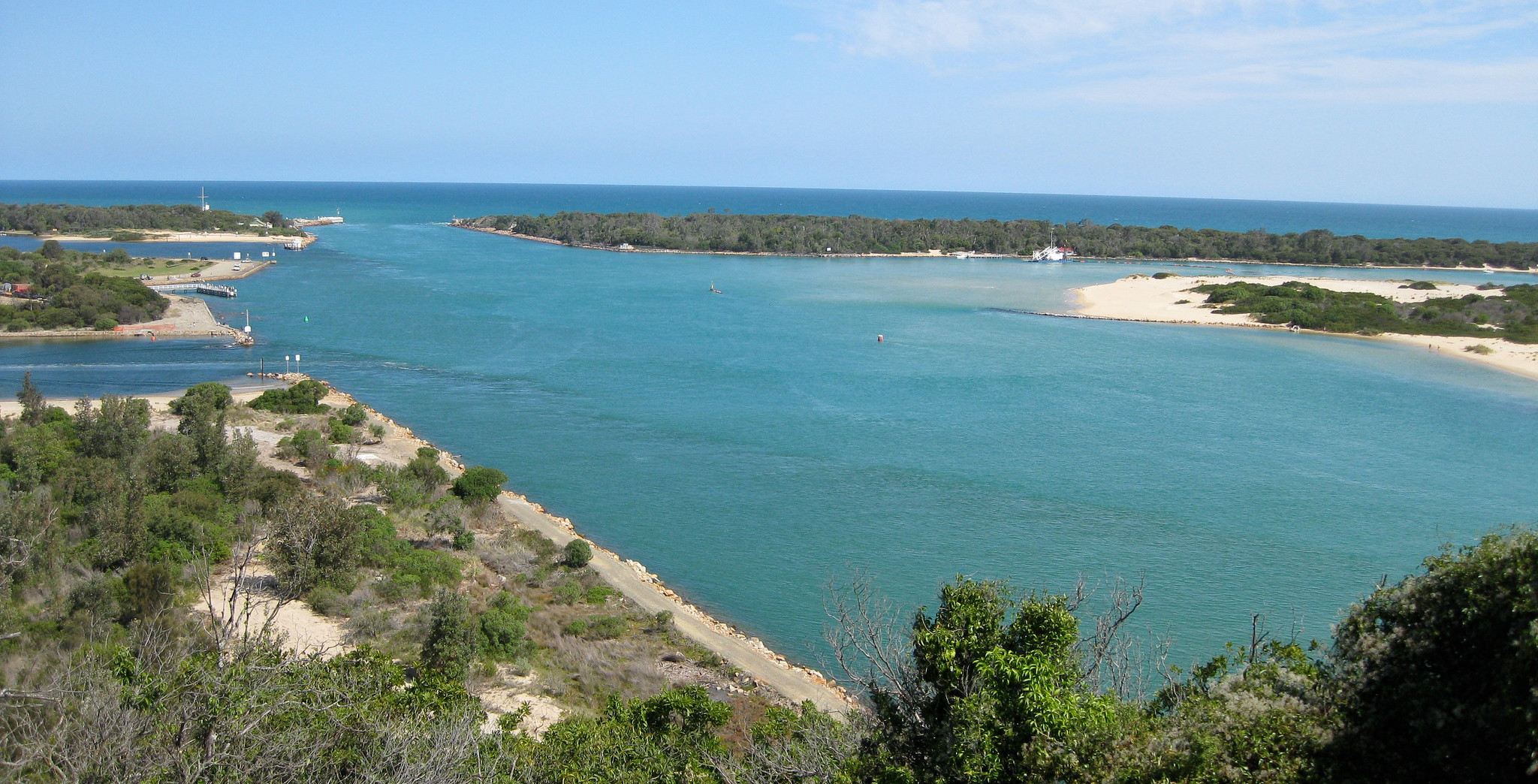
Lakes Entrance is a town located near the sea entrance of Victoria’s tidal Gippsland Lakes, a vast area of interconnected tidal waterways.
The lakes cover an area of about 350sqkm between Lakes Entrance, Bairnsdale and Sale.
The largest waterways are Lake Wellington, Lake King and Lake Victoria. These are fed by the Avon, Thomson, Latrobe, Mitchell, Nicholson and Tambo Rivers, and the lakes drain into the Bass Strait through the sea mouth 2km southwest of Lakes Entrance CBD.
To the east is the separate Lake Tyers, a small tidal waterway often closed to Bass Strait, but sometimes opened by prevailing weather and water levels. Though smaller than the above-mentioned lakes it is mostly navigable by recreational vessels and fishes well.
Lakes Entrance and the Gippsland Lakes region offers a bit of everything, including surf, estuary, offshore and freshwater fishing.
The sea opening is not safe for trailer boats, but the lakes themselves produce plenty of fish.
Landbased anglers can try the following fishing spots …
*Eastern Beach off Eastern Beach Rd for salmon, tailor and mullet;
*Kalimna Jetty for bream, luderick, flathead, tailor and salmon;
*Kalimna Wall for luderick and bream;
*Nungurner Jetty and the north side of Reeve Channel;
*Fishermen’s Wharf at Paynesville;
*Crane Jetty at Shaving Point (mulloway);
*Raymond Island Jetty; (bream and flathead)
*Montague Point (bream and big flathead);
*Point Harrington spit (flathead and flounder);
*Resides Jetty north of Point Scott.
Garfish, whiting, salmon and flathead are abundant in the lower lakes, with bream and estuary perch upstream.
Using lures is a way to avoid some of the juvenile bream.
Artificial reefs have been installed in the lakes and these host a range of species.
The Tambo River has good bream, with bankside fishing spots.
Access to the Tambo is below the Princes Hwy Bridge via the Metung Rd and above the bridge via the Upper Tambo Rd.
Downstream access is via McFarlanes Rd. Launch boats at the Johnsonville ramp.
The river mouth into the lake is a great place for big bream, especially after rain.
Marshalls Flat on the west bank is a popular landbased area, as is Rough Rd, off Metung Rd.
The upper river fishes best in dry weather. mulloway are caught.
The Nicholson River has little landbased access, but the small area called The Pear Tree, on the west bank about 1.5km below the Princes Hwy bridge, is a good spot.
A boat ramp is near the highway.
Bream, luderick and flathead are throughout the river.
The Mitchell River has a boat ramp at Eagle Point gives access to good spots such as The Cut, where the river flows into Jones Bay. Bream, estuary perch, flathead, mullet and garfish are caught.
Landbased fishing is at East Riverbank Rd and at the jetty next to the Lucknow Bridge.
The upper river’s snags fish best in summer.
Lake King fishes best after rain, which forces fish out of the rivers.
Eagle Point Bay is good after rain when fish are flushed from Mitchell River.
The same applies for Tambo Bay and Salt Creek near the Tambo River.
Jones Bay is good for pumping bait, and fishes best after heavy rain. Lake Wellington is a large lake with an average depth of only 2.5m.
It is fed by the Avon, Perry and Latrobe Rivers, and at the south-east end drains into Lake Victoria through McLennans Strait.
There is no tidal influence.
On the north shore, Marley Landing, which is 1km west of the Avon River entrance into the lake, gives access to the Avon River mouth, with flathead, whiting and bream.
On the south bank, Bull Bay has a launch site on a track off Seacombe Rd.
A boat ramp is at Seacombe at the top of the strait. The strait has bream and estuary perch, with luderick in autumn. The lake can become rough.
Lake Victoria
Lake Victoria is 25km long and 2.5km wide, with an average depth over 5m.
It has very little tidal influence. Water flows through McLennans Strait if wind or rain changes the lakes’ levels.
Bream, garfish, mullet, luderick, trevally, tailor, flounder and flathead are the main species.
Loch Sport is the access point, reached from Sale or Rosedale on the Princes Hwy, then from Longford via Collier Hill from the South Gippsland Hwy.
There is a jetty and good boat ramp.
Holland’s Landing on the north side of McLennans Strait has a van park. The 9km strait holds most species, including estuary perch.
Jones and Blond Bays are good bream areas.
flathead and whiting are caught on the channel edges.
Flounder spearing is popular in both lakes.
LaTrobe River has carp, mullet and bream. The river is navigable from Lake Wellington to Sale, via the Thompson River, but is not popular.
Ninety Mile Beach extends from Lakes Entrance to McLoughlins Beach in South Gippsland.
In summer there are snapper, flathead and occasional mulloway.
Elephant fish and gummy sharks bite at night.
Snapper are best in Oct/Nov, but bite all summer.
Winter produces salmon.
Good access, travelling south, is at Paradise Beach, Golden Beach, Delray Beach, Seaspray – from Longford – and Woodside and Reeves Beaches further south.
Fishing near Merrimans Creek mouth near Seaspray during flooding produces mulloway.
Here is a list of recommended tackle for Victorian waters.

Lakes Entrance weather and tides
Lakes Entrance coastline on Beachsafe
Gippsland Lakes artificial reefs
VIC fishing regulations
VIC marine parks
Return to the VIC fishing map
Email corrections, additions, pictures or video here.