Category Archives: Fishing Spots

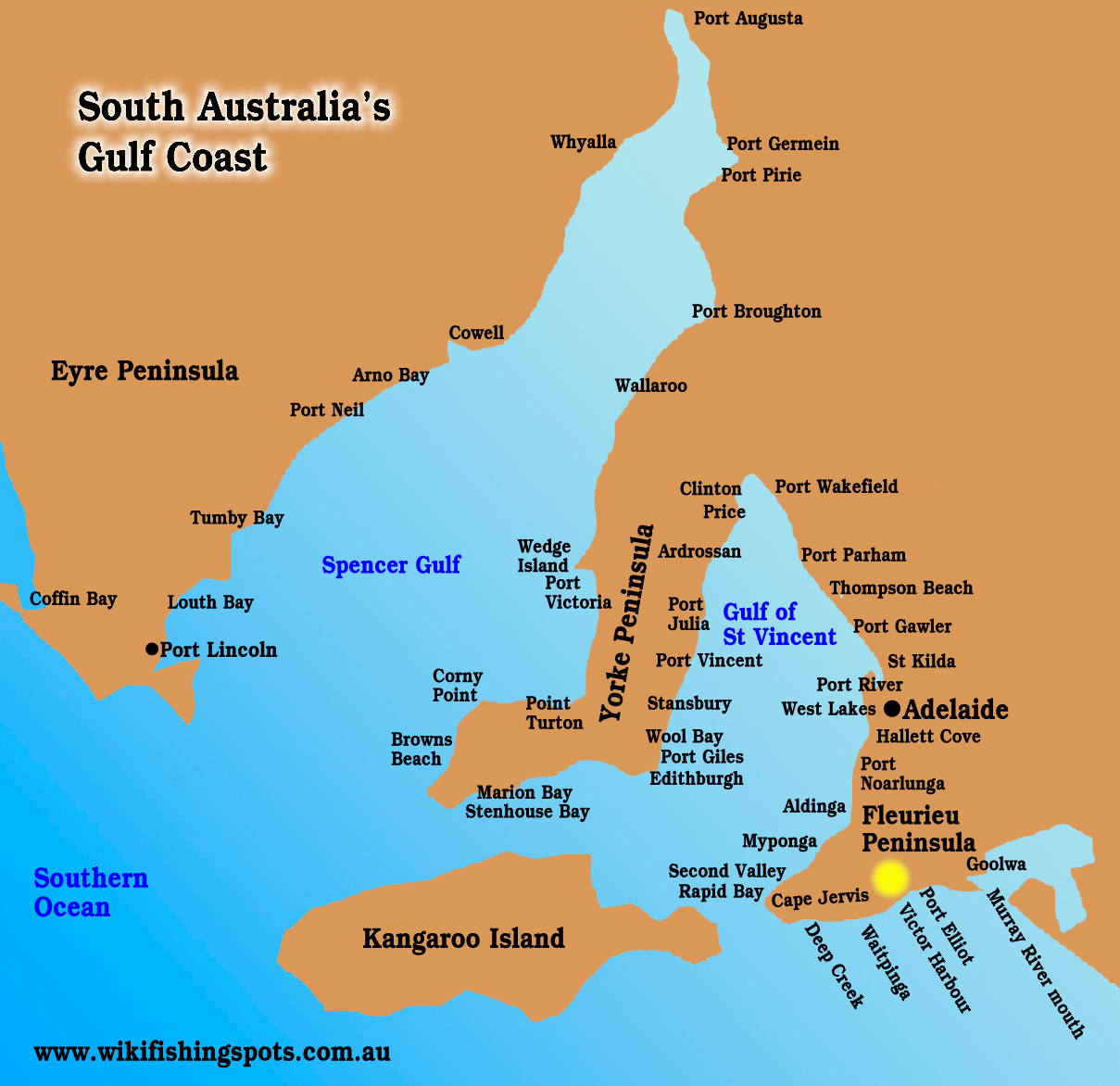
Victor Harbour, South Australia

Victor Harbour, South Australia

Victor Harbour is a hugely popular weekend destination for Adelaide fishermen.

Being outside the shelter of the Gulf of St Vincent, the rugged coastline between “Victor” and Cape Jervis has deeper beaches and rock platforms that tend to produce bigger fish than the shallower gulf beaches.

Victor Harbour has a sheltered boat ramp, but the ocean outside must be treated with respect.

The area inside Granite Island is a useful anchorage largely protected from ocean swell.

Granite Island is the main attraction for landbased fishos. It is accessed on foot via a long causeway over shallow weedbeds.

It is quite a walk over the causeway and to the popular Screwpile Jetty, so take a trolley if you fish with a lot of gear.

The Screwpile Jetty is short but borders deep water and produces salmon, snapper, seven-gill sharks, barracouta, mulloway, silver trevally and gummy sharks, as well as tommy ruff, sweep and chow.

The jetty runs hot or cold but the chance of quality fish keeps fishos coming back.

Snapper and mulloway bite best at dusk and dawn.

Near the Screwpile Jetty is an ocean rock wall that shields the jetty.

This rock wall produces just about anything, including some cracker sweep, but should not be fished in a swell as waves can break over the top.

The island’s causeway is good for gar and squid.

Boaters will find squid, gar, tommy ruff, KG whiting, salmon, snapper, leatherjackets and snook on shallow reefs and over seagrass around Victor Harbour.

Boaters who want to fish inshore for mixed species should try grounds between Granite Island and Wright Island.

Bluefin tuna are reliable in season and are targeted in canoes by adventurous fishos.

Nearby, Rosetta Head (The Bluff) has a small jetty that is popular with squid fishos.

Victor Harbour beaches fish well for mullet in autumn/winter, with salmon trout all year, and occasional big mulloway.

Port Elliot’s small jetty has produced big mulloway.

See the region’s beaches here.

Victor Harbour’s Hindmarsh and Inman Rivers usually have black bream, with redfin and carp upstream.

Use an unweighted or very lightly weighted bait of peeled prawn in the rivers for bream.

Trout occur in the upper Hindmarsh River, with good fly fishing in years past, but access is difficult.

The short section of the Hindmarsh from the second waterfall down to the gauging weir was historically stocked with trout.

Prawns, squid and cockles (pipis) are all good baits for general saltwater fishing around Victor Harbour.

Mince meat is often used for yelloweye mullet.

Be sure to take some squid jigs to Victor Harbour. Squid almost always are best at dawn and dusk, and at night.

Off the surf beaches, any surf rod that can cast a chrome-slice lure a reasonable distance will catch salmon trout, which are usually about. They also respond to most types of bait.

A live salmon trout or mullet makes a great bait for mulloway, look for a deep gutter and fish a large high tide, with night fishing most likely to succeed.

Because of its popularity with Adelaide folk as a seaside destination, accommodation over holiday periods tends to book out early.

Here is the SA seasonal fishing calendar for various fish species.

A reminder that special snapper rules apply in SA, and new restrictions were announced following a destructive marine algal bloom ... view details here.

Victor Harbour weather and tides
Victor Harbour coastline
Victor Harbour accommodation
SA fishing regulations
SA marine parks
Return to SA Fishing Map

NOTE: Special snapper rules apply in SA. More recently, new restrictions were announced following a destructive marine algal bloom … view them here.

Email corrections, additions, pictures or video here.
Fishing the Savannah Way

The eastern Top End is an exciting region for touring fishos, being far from population centres and therefore receiving less fishing pressure.

The habitat is first class, but fishing quality changes markedly with the seasons, depending on wet season rainfall.

Adventurous fishos who explore the coast in a boat will find tidal creeks that hardly see a lure or bait.

Most who visit here only fish the rivers and creeks, so the shallow reefs along the coast are hardly fished.

The eastern Top End has some of the Northern Territory’s great barramundi rivers, such the Roper, Limmen and McArthur.

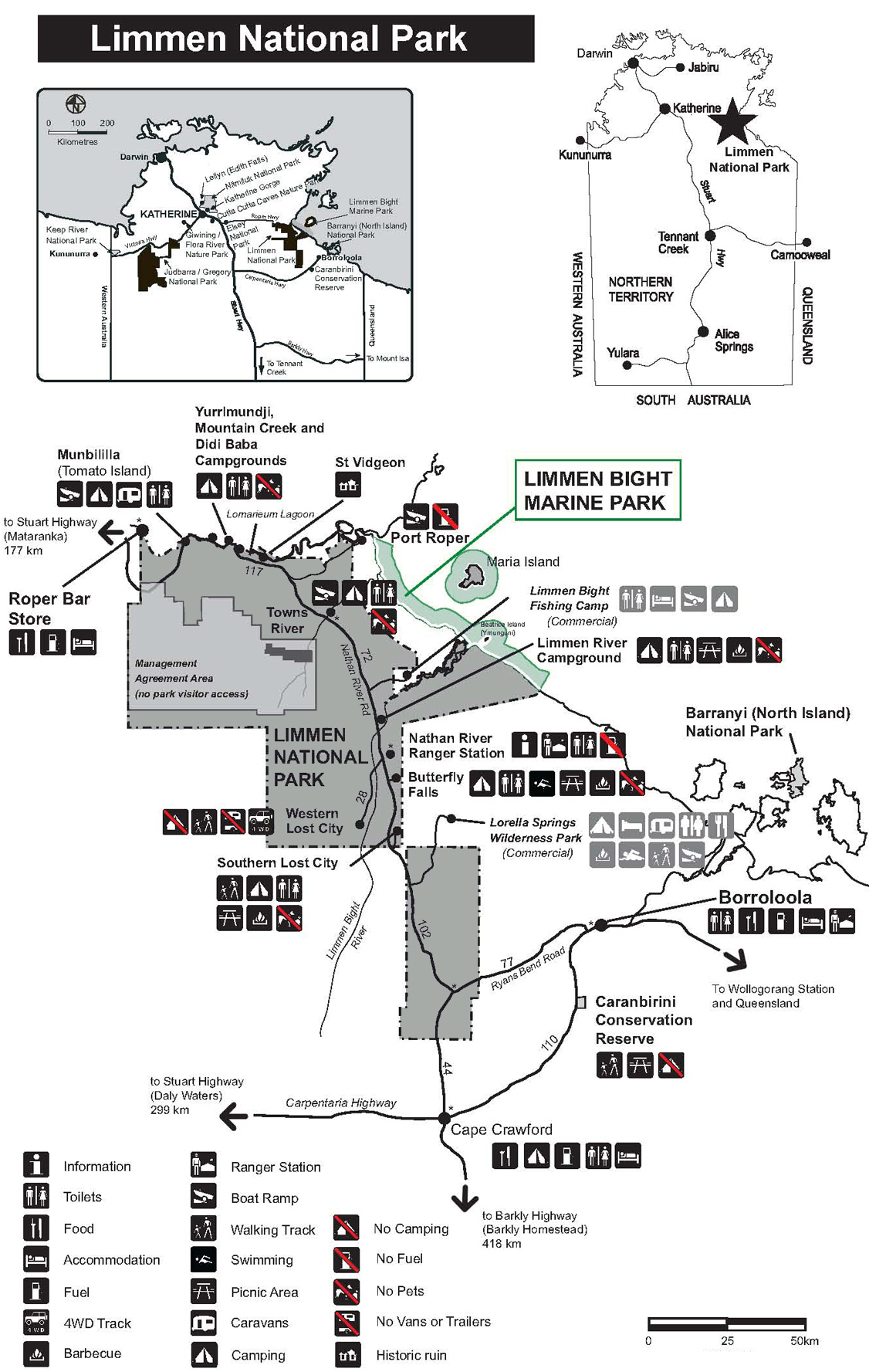
The central feature of this area for travellers is Limmen National Park, declared in July 2012.

There are several camping areas within the park. Munbililla (also called Tomato Island) is the most important for fishermen.

Limmen Bight Fishing Camp and Lorella Springs Wilderness Park on Rosie Creek are located outside the national park.

Boat launch sites are at Roper Bar, Munbililla, Port Roper, Towns River, Limmen Bight Fishing Camp, Rosie Creek, Robinson River, Mule Creek and McArthur River.

Visitors can drive in from the north or south, but the roads are subject to closure from annual wet season flooding, and are often corrugated.

Call Parks and Wildlife in Katherine (08 8973 8888) or Nathan River Ranger Station (08 8975 9940) for road info, and Katherine Rod and Rifle (08 8972 1020) for the latest fishing info.

Munbililla (Tomato Island) campground on the Roper, opened in 2013. This used to be just a clearing in the bush near the concrete boat ramp, but it became so popular a proper campground was needed. It has ablution facilities and a ranger station.

Port Roper, at the river mouth on the south bank, has a concrete ramp and cleared space in the bush nearby that is used for camping. This is a “roughing it location” but huge barramundi, groper, salmon and jewfish are caught.

Small tides are best at the Roper mouth, which are difficult to determine as the river has sometimes unpredictable tides because of quirks of the shallow Gulf of Carpentaria.

South of the Roper is the smaller Towns River, which has camping near the riverbank, with an associated ablution block.

The Towns has good barra fishing and crabbing, but the fish are on average smaller than Roper fish.

South again is the Limmen Bight River, which offers a bush camping experience along the river banks at Steve Barrett’s private fishing camp.

The campsites are unimproved, next to tidal water, and boats can be moored nearby, but they will dry out at low tide.

Fish the Limmen on reasonably large tides.

Being sandy, it is quite clear, and even the last creek at the mouth can have several feet of water clarity unless the wind stirs it up.

Small tides are not always ideal for chasing barramundi, with the exception being in rivers with turbid waters.

Centre Island tides provide approximate tide times to plan your Limmen River trip.

Mining traffic diminished with the closure of local mines in 2014 after a commodity slump, but there are still heavy vehicles using the highway.

Visitors must take most supplies in.

Fuel is at Borroloola, Hells Gate, Robinson River community and King Ash Bay (McArthur River). Roper Bar store was closed at publication of this post but nearby Urupunga store sells to the public.

The Limmen camp supplied fuel in jerry cans at our last inquiry.

Tank water is at the Limmen camp only if there has been enough rain. Call first.

Keep in mind that the road is closed each year for the wet season. The roads are rough and can break trailers.

Back to the NSW/ACT Fishing Map
Back to the NT Fishing Map
Back to the Queensland Fishing Map
Back to the SA Fishing Map
Back to the Tasmanian Fishing Map
Back to the Victorian Fishing Map
Back to the WA Fishing Map

Email corrections, additions, pictures or video here.

The Ningaloo Coast, Western Australia

The coast from Warroora Station to Exmouth Peninsula, incorporating Ningaloo Reef, makes up one of Australia’s most spectacular marine habitats, and it has some of Australia’s best coastal camps.

Beach camps are run by WA parks authorities.

Most camps have easy access to beach fishing, but not all have boat launch sites.

For government camps, check the website www.parks.dpaw.wa.gov.au for the latest info to plan your trip.

Ningaloo is Australia’s largest fringing coral reef, at 260km long. It lies just 100m offshore at its closest point, and less than 7km at its furthest.

The Continental Shelf lies just 18.5km out.

Ningaloo Marine Park was opened in 1987 and covers 4000sqkm from Amherst Point in the south to Bundegi Reef in Exmouth Gulf to the north.

The park extends about 18.5km to sea.

Coral Bay has the only proper boat ramp in the immediate area, but there are beach launching sites.

On the stations, drivers must stick to tracks to prevent dune erosion, and carry fuel, food and water.

Visitors must take rubbish home and campers in some areas must have portable toilets.

Be prepared for private bag limits. Warroora Station, for example, has a 5kg fish fillet limit.

Ningaloo waters provide flats, beach, reef and offshore game fishing opportunities.

The beaches have permit, bonefish, queenfish, golden trevally and spangled emperor in the reef lagoons. Fly fishos have fine sport.

Out wide are emperor, cod, tuskfish, coral trout, mackerel, trevally, cobia and more.

Because the Continental Shelf comes close to the mainland, trailerboaters have a rare chance to catch blue, black and striped marlin, sailfish, wahoo, dolphin fish, mackerel and even broadbill swordfish.

Ningaloo has great dive sites from Gnaraloo through to Exmouth.

Whale sharks to 12m long are sighted from March to May, as they swim near the surface.

Whales are commonly seen near shore mid-year.

Fishing charter boats work from Coral Bay and Exmouth.

Fishermen can have a fine time using a dinghy at Ningaloo during calm weather.

However, to go outside the reef requires a seaworthy boat.

Getting there

The Ningaloo region is 700km north of Perth, and 130km north of Carnarvon.

A 4WD vehicle is not needed within much of the Cape Range National Park that encompasses the Ningaloo coast, but is needed to drive beyond Yardie Creek.

The Yardie Creek crossing can be hazardous when the sand is low and there is tidal influence.

Sand driving in this area requires deflated tyres.

To reach Warroora Station, from the north take the Warroora Northern access 15km south of the Coral Bay turn-off.

Seasons

Most visitors come between April and November.

High temperatures, strong winds and cyclones discourage summer visits.

Good fishing is had all year.

Bait & Tackle

A good surf rod is a must for beach and rock fishing in this area, together with some chrome lures for distance casting.

Balloon rigs are popular for getting baits out to the fish.

Ganged hooks and pilchard baits work well on tailor, mackerel, cobia and reef fish too.

Boat fishing requires everything from handlines to trolling and spinning rods.

Pelagic fish schools are common, so a spinning rod is a must.

Rock fishing outside the confines of the reef lagoons is dangerous. Never fish the lower ledges.

Boat launching

There are sealed ramps at Bundegi (north of Exmouth), Tantabiddi Creek and near Coral Bay.

Beach launching is required in many places, and is the only way south of Yardie Creek.

The beaches are generally calm as they are inside the protective reef.

Ningaloo tides
Book Ningaloo camping
Quobba Station
Warroora Station
WA fishing regulations
Ningaloo Marine Park map
Ningaloo Marine Mark – state
Ningaloo Marine Park – federal
Return to WA Fishing Map

Email corrections, additions, pictures or video here.
